The practice

What I work on

I work directly with a small number of businesses. This is what I take on, what it costs, and what I don’t do.

If one of these sounds familiar, we should talk.

We don’t show up when people search for what we do.

Almost always structural rather than competitive. Search engines rank what they can read and resolve into a coherent business; if your pages carry no structured data, inconsistent contact details, and no clear entity, you are hard to rank whatever you spend. That is a technical gap, not a marketing one.

Our website is out of date and I’m not comfortable sending people to it.

That instinct is worth trusting — the people deciding whether to call you are looking at it too, and most of them decide before they contact you. A site that undersells a serious business is not a cosmetic problem; it is the first thing your buyer weighs.

We’re spending on advertising and not getting much back.

Advertising creates attention. What happens next decides whether it converts: most buyers check you out before they act, often weeks later. If what they find is thin or contradicts the ad, the spend has bought a visit to a place that loses them. The ads are rarely the broken part.

Why doesn’t my business show up when people ask AI about my industry?

Because AI systems can only recommend what they can read. Without structured data, consistent entity signals, and a machine-readable description of what you do, you are invisible to them — however good the business is. I can measure this and make you readable. Nobody can guarantee what an AI says.

Nobody can tell me exactly what runs where. Is that a problem?

Yes, and it is the most common one I find. When no one can say which server, domain, or account owns which part of your presence, you cannot secure it, move it, or fix it quickly. The first deliverable of any engagement is a map of what actually exists.

Who is actually responsible for our digital side?

Usually nobody, which is why it drifts. A digital presence needs an owner the way a building needs a facilities manager — someone accountable for uptime, security, updates, and improvement. That is what an operating relationship is, and it is the part most agencies do not sell.

Four stages. Start at the first one.

You can stop after any of them, and take everything with you. Most people start with the Check because it is the only honest way to quote the rest.

Check EGP 12,000

Fixed price · one-off · comes off the build

What people actually find when they look you up — search results, AI answers, your identity across every surface, and what you do and don’t own. Findings in plain language, with the evidence attached.

  • Where you stand, with evidence
  • What you don’t own
  • What it is costing you
  • What to fix, in order
Build from EGP 75,000

Project · scoped from the Check

The digital foundation, on infrastructure in your name: site, domain, business email, analytics, structured data, and the documentation that makes it operable by someone other than me.

  • Site and infrastructure you own
  • Email that reaches inboxes
  • Measurement switched on from day one
  • Handover pack at launch
Run from EGP 7,500 / month

Monthly · cancel any time · no lock-in

Somebody is responsible. Uptime, security, backups, renewals, and the changes you ask for — plus a monthly report in plain language of what happened and what I did about it.

  • Nothing lapses, nothing breaks silently
  • Changes made when you ask
  • Enquiries reach you and are recorded
  • A monthly report you can actually read
Improve scoped per programme

Project or ongoing · optional

Making the business easier to find, understand and choose: search visibility, structured content, the surfaces buyers check before they call. Measured, and reported the same way.

  • Search and AI visibility measured
  • The gaps closed in priority order
  • Reported against where you started

These are starting points, not a price list. Every engagement is still scoped from what the Check finds — but you should be able to tell before you call whether we are in the same range.

Also available, outside the ladder: architecture review and second opinions (fractional CTO), and speaking or writing on machine legibility and entity architecture.

What happens after you say yes →

What that standard looks like. Real businesses, live today, built and still operated under the process above.

SOS Trading and Contracting — homepage as it runs today
SOS Trading and Contracting · captured 2026-07-31
MAXIM Group — homepage as it runs today
MAXIM Group · captured 2026-07-31
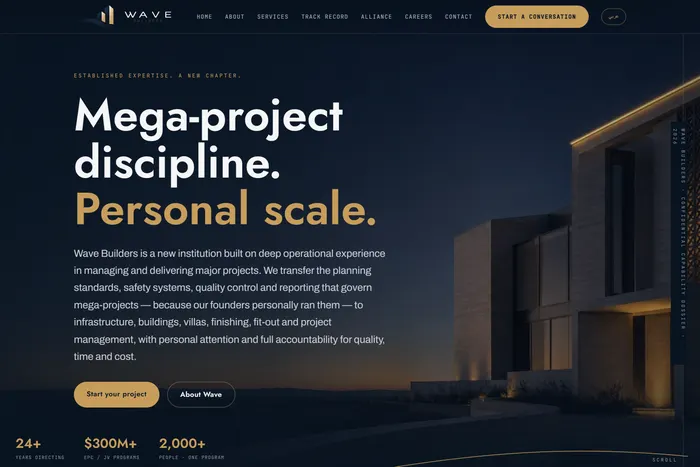
Wave Builders — homepage as it runs today
Wave Builders · captured 2026-07-31

Six things that don’t change.

Diagnose before building

Every engagement starts with the Check. You get the findings whether or not you build with me, and the fee comes off the build if you proceed.

Architecture, not aesthetics

I work on the structural layer: infrastructure, entity structure, data flow, automation. Presentation matters, but it is not what is broken in most of the businesses that call me.

You own everything

Your domain, your infrastructure, your data, your code — in your name, not mine. Not a promise in a contract: a handover pack you can ask for at any time and check for yourself. See below.

Everything is documented

Every decision recorded, every system reproducible by someone who is not me. A system only one person understands is a liability, even when that person is the one you hired.

I operate what I build

A digital presence is never finished. Launch is the beginning of the work, not the end of it — which is why the operating relationship matters more than the build.

Every defect becomes a mechanism

When something breaks once, it becomes an automated check that runs before every release. That is how the same mistake stops being possible instead of just being fixed.

“You own everything” — here is what that actually means.

Every provider says it. Ask them for this list. It is the difference between a sentence in a contract and something you can check.

Handover pack Available on request, at any time
  • Domain registered in your name, in an account you control
  • Hosting and DNS in your name — I hold access, not title
  • Full source code, and the repository it lives in
  • Analytics and search accounts owned by you, with me added as a user
  • Written documentation of what runs where, and how to operate it
  • A copy of all of it, any time you ask — not only when you leave

If you ever leave, nothing has to be rebuilt and nothing has to be asked for politely. That is not generosity — it is what owning your own business online should have meant all along.

Just as important: what I don’t do.

Paid media

No ads, no media buying, no ad-account management. I build authority; I don’t rent attention.

Brand design, photo, video

Specialist craft. I bring partners in for it rather than pretend it’s the same discipline as mine.

Guaranteed rankings or traffic

Nobody can promise algorithmic outcomes. Anyone who does is selling you something other than what they say.

A promise about what AI says

I can measure whether you appear in AI answers and make you readable to the systems that generate them. What they choose to say is not mine to guarantee — and the honest version of that sentence is the whole difference.

Leads, or a number of them

I am accountable for what people find and whether every enquiry reaches you. Whether they buy is your business, your market, and your sales — and I won’t price it as if it were mine.

I take a small number of engagements at a time. That’s a deliberate constraint, not a sales tactic — the work only holds up at that scale.

Working together

Client work starts with a conversation — no commitment, no pitch. If it turns out I'm not the right fit, I'll say so.